Your Equipment Is Telling You Something — You're Just Not Listening
A 200-horsepower motor doesn't fail silently. Weeks before the shaft seizes, before the bearing collapses, before your third-shift operator calls you at 2 AM — the machine is vibrating differently. The question is whether anyone is paying attention.
Vibration analysis is the most reliable method for catching mechanical faults before they become catastrophic failures. For Ontario manufacturing plants running 24/7 production lines, the difference between a planned $4,000 bearing swap and a $180,000 unplanned shutdown comes down to one thing: whether you're measuring vibration or hoping for the best.
If your plant is still running on calendar-based maintenance, talk to one of our engineers about what a condition-based programme looks like. No pitch — just an honest conversation about your equipment.
What Vibration Analysis Actually Is (And Why It Works)
Every rotating machine produces a vibration signature. When the machine is healthy, that signature is predictable and repeatable. When something goes wrong — a bearing starts to pit, a coupling drifts out of alignment, a fan blade accumulates buildup — the signature changes.
Vibration analysis is the practice of measuring those changes, interpreting them, and making maintenance decisions based on what the data tells you. It's not guesswork. It's physics.
The P-F Curve: Your Window of Opportunity
The P-F curve is the single most important concept in predictive maintenance. Here's how it works:
- Point P — the moment a fault becomes detectable. Not visible to the naked eye, not audible, but measurable with the right instruments.
- Point F — functional failure. The machine stops working. Production stops. Your phone rings.
The distance between P and F is your intervention window. For vibration-related faults, that window is typically 1 to 9 months. Compare that to thermography (weeks) or audible noise (days, sometimes hours).
Vibration analysis gives you the longest P-F interval of any condition monitoring technique. That's not an opinion — it's documented across ISO 10816 and decades of field data from rotating equipment programmes worldwide.
What does that mean in practice? It means you catch the fault in January, order the part in February, and schedule the repair for a planned shutdown in March. No overtime. No emergency freight. No lost production.
The 4 Faults Vibration Analysis Catches Every Time
Vibration analysis doesn't detect every mechanical problem. But it catches the four that cause 80% of rotating equipment failures. Here they are, in order of frequency.
1. Imbalance
An uneven mass distribution on a rotating component. Think of a ceiling fan with one blade heavier than the others — except your fan weighs 2,000 kg and spins at 3,600 RPM.
Vibration signature: Dominant 1X frequency (once per revolution). Amplitude increases with speed squared — a small imbalance at low RPM becomes a serious problem at operating speed.
Common causes in Ontario plants: Material buildup on fan blades (especially in pulp and paper operations), missing balance weights after maintenance, uneven wear on impellers.
If left unchecked: Accelerated bearing wear, seal failures, shaft fatigue cracking. A $200 balance correction becomes a $15,000 bearing replacement in 6 months.
2. Misalignment
The centrelines of coupled shafts don't line up. Either angular (the shafts meet at an angle) or parallel (the shafts are offset). Usually both.
Vibration signature: Strong 2X frequency (twice per revolution) with elevated axial vibration. Misalignment is one of the few faults that shows up clearly in the axial direction.
Common causes: Thermal growth after startup (especially common in Ontario winters where ambient temperature swings of 40°C between seasons stress equipment), soft foot, improper coupling installation.
If left unchecked: Coupling failures, seal leaks, bearing overload. One Ontario automotive parts manufacturer we worked with was replacing flexible couplings every 8 months. The root cause was 0.15 mm of parallel misalignment — a 45-minute laser alignment correction eliminated the recurring failure entirely.
3. Mechanical Looseness
Something that should be tight isn't. Loose bolts, worn bearings in their housings, cracked mounting frames.
Vibration signature: Sub-harmonic frequencies (0.5X) and a "noisy" spectrum with many harmonics. The vibration waveform often shows truncation or clipping — the classic signs of a component bouncing or rattling.
Common causes: Foundation deterioration (a real problem in older Ontario manufacturing facilities built in the 1960s-70s), fastener fatigue, worn keyways.
If left unchecked: Catastrophic failure. Loose components generate impact forces that accelerate wear on everything around them. We've seen loose foundation bolts progress to a cracked bearing pedestal in under 3 months.
4. Bearing Wear
The most critical fault to catch early, because bearing failure is the most common cause of unplanned downtime in rotating equipment.
Vibration signature: High-frequency energy in the envelope (demodulated) spectrum. Specific bearing defect frequencies — BPFO, BPFI, BSF, FTF — tell you exactly which part of the bearing is damaged. Early-stage bearing wear shows up in ultrasonic frequencies (20-50 kHz) long before it appears in the standard vibration spectrum.
Common causes: Lubrication failures (wrong grease, wrong quantity, wrong interval), contamination, installation damage, overloading.
If left unchecked: Bearing seizure, shaft damage, collateral damage to adjacent components. A $300 bearing becomes a $40,000 repair when the shaft scores and the housing needs re-machining.
Ontario-Specific Context: Standards and Compliance
Ontario manufacturers don't operate in a vacuum. Your vibration analysis programme needs to align with Canadian regulatory and safety requirements.
CSA Z463 — Maintenance of Electrical Equipment
CSA Z463 governs maintenance practices for electrical equipment in Canadian workplaces. While it's primarily focused on electrical systems, its framework for condition-based maintenance applies directly to vibration monitoring of motors, generators, and motor-driven equipment.
If your plant follows CSA Z463 (and in Ontario, you should be), vibration analysis on critical motors isn't optional — it's part of your compliance framework.
ESA Compliance and Motor Reliability
The Electrical Safety Authority regulates electrical safety across Ontario. Motors that fail catastrophically can create arc flash hazards, and ESA investigations after incidents routinely ask whether the facility had a condition monitoring programme in place. Vibration analysis on critical motors provides documented evidence that you're managing motor health proactively.
Ontario's Manufacturing Sector: The Numbers
Ontario remains Canada's manufacturing heartweight. Over 50,000 manufacturing establishments employ roughly 800,000 workers across the province. The automotive, food processing, steel, and chemical sectors all depend on rotating equipment that runs 20+ hours per day.
Here's the problem: the average Ontario manufacturing plant still spends 35-45% of its maintenance budget on reactive (break-fix) work. That's money spent on emergency parts, overtime labour, and lost production. Plants that implement vibration analysis programmes consistently reduce that reactive spending to under 15% within 18 months.
Running a facility in Ontario with critical rotating equipment? Talk to an engineer about a baseline vibration assessment. We'll tell you which machines need monitoring and which ones don't — no fluff, just data.
Real Cost Savings: What the Data Shows
We don't deal in vague promises. Here are the numbers from actual programmes across Ontario manufacturing facilities.
Avoided Catastrophic Failures
The average cost of an unplanned shutdown in a mid-size Ontario manufacturing plant is $180,000. That includes lost production, emergency labour, expedited parts, and downstream supply chain penalties. One avoided shutdown per year pays for a comprehensive vibration analysis programme 3-4 times over.
Maintenance Cost Reduction
Plants that transition from calendar-based to condition-based maintenance using vibration analysis see a 40% reduction in overall maintenance costs within the first two years. That's not aspirational — it's the median outcome across our client base.
The savings come from three places:
- Fewer emergency repairs — you're fixing things on your schedule, not the machine's
- Extended component life — bearings replaced at the right time last 30% longer than bearings replaced on a calendar schedule (because many get replaced too early)
- Reduced parts inventory — when you know what's going to fail and when, you don't need a warehouse full of "just in case" spares
Labour Efficiency
A reactive maintenance team spends 55% of its time on unplanned work. A team supported by vibration data spends less than 20% on unplanned work. The rest goes to planned, efficient maintenance — the kind where the parts are staged, the lockout/tagout is pre-arranged, and the job gets done in half the time.
Vibration Analysis vs Other Condition Monitoring Methods
Vibration analysis is the backbone of any predictive maintenance programme for rotating equipment. But it's not the only tool in the box.
| Method | Best For | P-F Interval | Limitations | |---|---|---|---| | Vibration analysis | Rotating equipment: motors, pumps, fans, turbines, gearboxes | 1-9 months | Doesn't detect electrical faults, corrosion, or process issues | | Thermography | Electrical connections, insulation, steam traps, refractory | 1-4 weeks | Limited penetration into equipment internals | | Oil analysis | Gearboxes, hydraulic systems, engines | 1-6 months | Requires sampling; not real-time | | Ultrasound | Compressed air leaks, steam traps, early bearing faults | Days to weeks | Limited fault diagnosis capability | | Motor current analysis | Electrical faults in motors (rotor bars, stator insulation) | 1-3 months | Only applicable to electric motors |
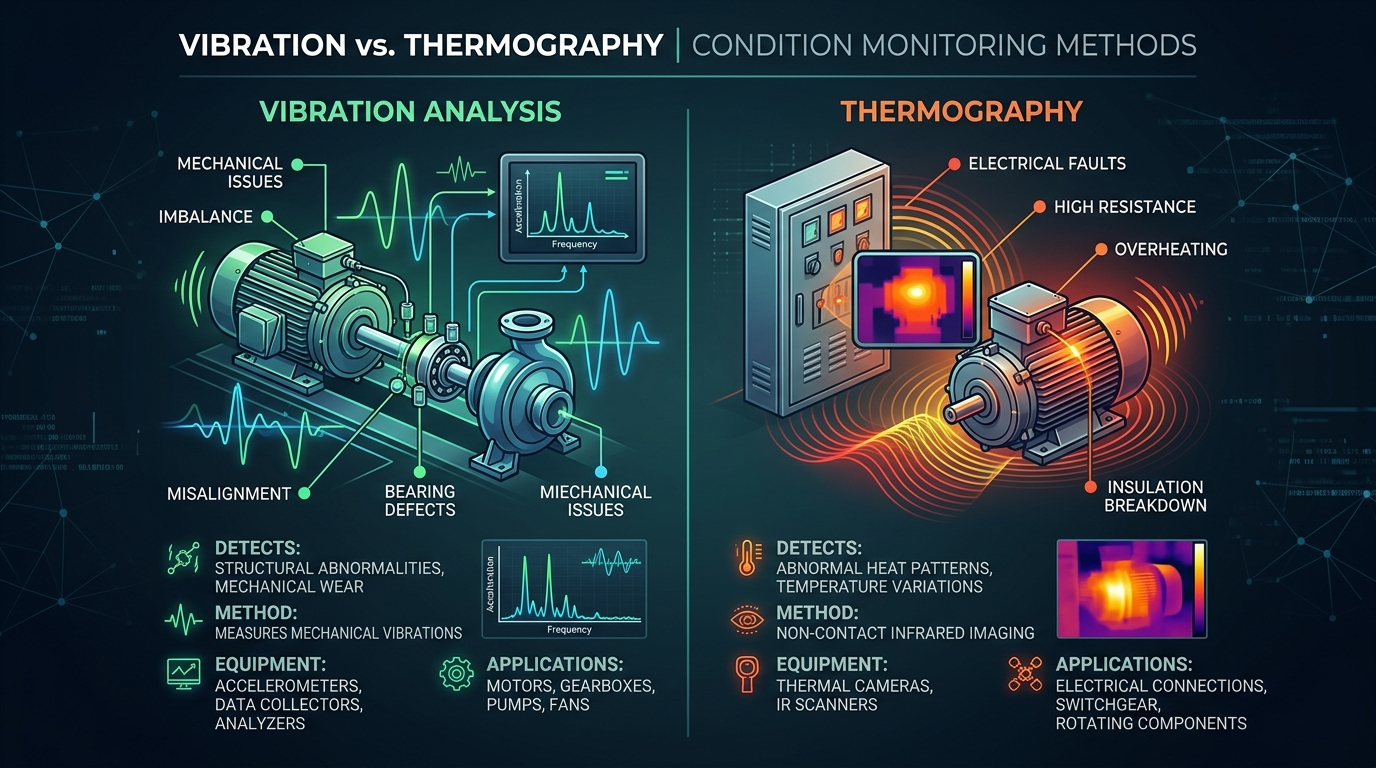
The real answer is that most Ontario plants need vibration analysis AND at least one other method. For a deep comparison of the two most common techniques, read our guide on vibration analysis vs thermography.
When Vibration Analysis Is the Wrong Choice
Honesty matters: vibration analysis doesn't make sense for every piece of equipment.
- Non-rotating equipment — heat exchangers, pressure vessels, piping. Use thickness testing and thermography instead.
- Small, inexpensive equipment — if the motor costs $500 and takes 30 minutes to swap, run-to-failure is the right strategy. Don't spend $2,000/year monitoring a $500 motor.
- Equipment with very low run hours — a backup pump that runs 50 hours per year doesn't generate enough vibration data for trend analysis.
Focus your vibration programme on equipment where failure has real consequences: production stops, safety hazards, environmental releases, or costs exceeding $10,000.
How to Start a Vibration Analysis Programme in Your Ontario Plant
You don't need to monitor everything on day one. Here's the practical path:
- Criticality ranking — Identify your top 20-30 machines by consequence of failure. Production impact, safety risk, environmental risk, repair cost.
- Baseline measurements — Collect initial vibration data on all critical machines while they're running normally. This is your reference point.
- Set alarm thresholds — Use ISO 10816 guidelines as a starting point, then refine based on your baseline data and operating context.
- Establish routes and intervals — Monthly collection is standard for most equipment. Critical machines may need continuous online monitoring.
- Train your team — Your reliability engineers need ISO Category II vibration analyst certification at minimum. Category III for programme management.
- Act on the data — The most expensive vibration programme is the one that collects data nobody reads. Every alert needs a defined response workflow.
Calendar-Based Maintenance Is Dead
If your Ontario plant is still pulling motors apart on a fixed schedule — every 12 months, every 18 months, regardless of condition — you're wasting money and introducing risk.
Here's a number that surprises people: 68% of premature bearing failures are caused by maintenance-induced damage. Every time you open a machine, you risk contamination, incorrect reassembly, and installation damage. Condition-based maintenance using vibration analysis means you only open machines when the data says something is actually wrong.
That's not just a cost argument. It's a reliability argument. Your equipment runs better when you stop touching it unnecessarily.
Your Next Step
Your plant's machines are already telling you what's about to fail. The question is whether you're going to listen.
Droz Technologies provides predictive maintenance services across Ontario, including vibration analysis, thermography, oil analysis, and programme development. We don't sell sensors and walk away — we build programmes that your team can own.
No sales pitch. Tell us what equipment you're running, what's been failing, and what it's costing you. We'll tell you exactly where vibration analysis fits — and where it doesn't.