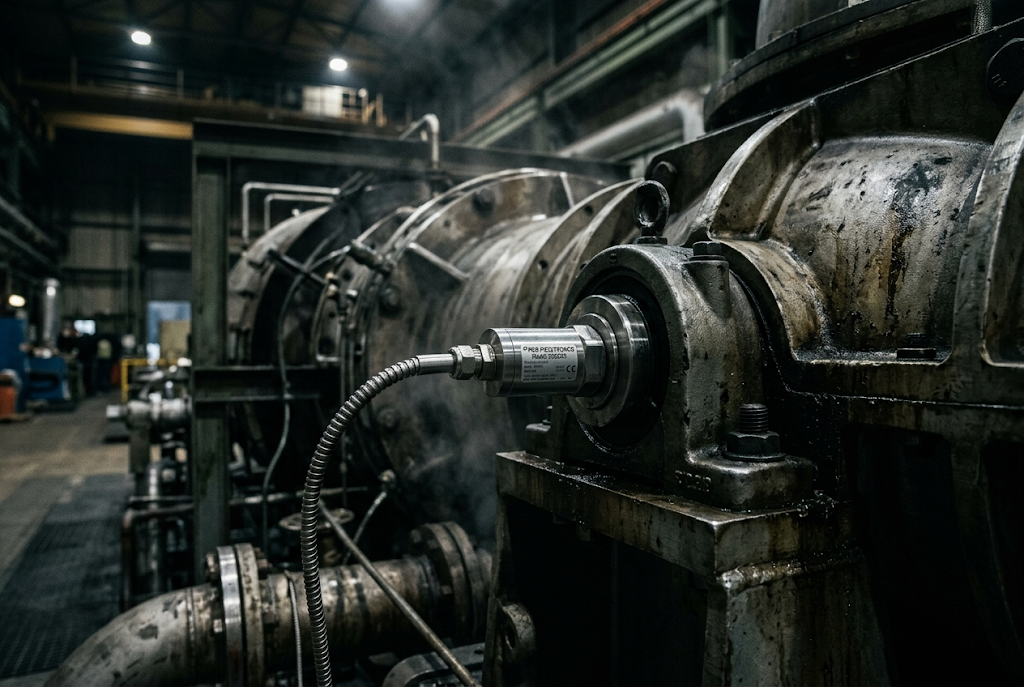
Why Vibration Analysis Catches Failures 3–6 Months Before They Happen
Most maintenance teams only see a bearing failure after it destroys the equipment. Vibration analysis reads the physics happening inside the machine weeks — sometimes months — before the first visible symptom appears.
A motor running at 1,800 RPM completes 30 rotations every second. Each rotation generates a distinct vibration signature. When that signature changes — even fractionally — something inside the machine is changing too.
That's the entire premise of vibration analysis. Not magic. Not guesswork. Physics.
What the Data Actually Tells You
Every rotating component has a natural resonant frequency. A healthy bearing running at 1,800 RPM produces vibration peaks at predictable intervals — what engineers call the Ball Pass Frequency Outer race (BPFO) and Ball Pass Frequency Inner race (BPFI).
When a bearing starts to deteriorate, it produces additional peaks. Micro-pitting on the race generates impacts at mathematically precise intervals. A trained analyst watching the spectrum sees those peaks appear weeks before any audible noise, before any heat spike, before anything a walk-around inspection would catch.
"We found a critical bearing fault at Stage 2 severity — 14 weeks before catastrophic failure — on a $380,000 compressor. The client paid $4,200 for the analysis. The repair cost $11,000. The avoided downtime cost: $160,000."
The Four Stages of Bearing Failure
Understanding failure progression is what makes vibration analysis useful rather than just interesting.
Stage 1 — Ultrasonic frequencies spike (20–60 kHz range). No vibration visible in normal spectrum. No human-perceptible symptom. Only ultrasound equipment or high-frequency vibration sensors detect this phase.
Stage 2 — Natural frequencies of bearing components excite. Still no audible noise. Acceleration spectrum begins showing sidebands around the bearing defect frequencies. This is where trained analysts first flag anomalies.
Stage 3 — Defect frequencies become prominent in the velocity spectrum. Machine is now audible to trained ears. Vibration levels rising. Most facilities still haven't scheduled a repair at this point.
Stage 4 — Broadband noise floor elevates. Random vibration dominates. Failure is imminent — days to weeks away.
Most reactive maintenance programs catch problems at Stage 4. Vibration analysis programs catch them at Stage 2.
Why 20 Years of Field Data Changes the Analysis
Pattern recognition in vibration analysis isn't just about knowing the formulas. It's about having seen the same failure pattern on 200 different machines, across different industries, under different load conditions.
A frequency peak at 3.2x running speed on a centrifugal pump means something different than the same peak on a gearbox. Context is everything. The physics is consistent — the interpretation requires experience.
Our predictive maintenance division has been doing this work since 2005. The database of fault patterns we've accumulated — combined with modern sensor technology — is what allows us to deliver fault detection timelines measured in months, not weeks.
What a Proper Program Looks Like
A structured vibration analysis program has three components:
-
Baseline establishment — Every machine in the program gets measured under normal operating conditions. That baseline becomes the comparison point for all future measurements.
-
Trend monitoring — Measurements at defined intervals (typically monthly for critical equipment, quarterly for standard). The trend line matters more than any single measurement.
-
Alarm thresholds — ISO 10816 provides velocity-based severity zones. But experienced analysts often flag machines before threshold violations, based on rate-of-change rather than absolute values.
The technology exists. The physics is well understood. The only variable is whether your maintenance program is structured to use it.
If you're running critical rotating equipment without a vibration monitoring program, you're operating on hope. That's an expensive strategy.