§ Practice 02 · Pillar A

Predictive Maintenance — field-tested, AI-amplified.

Two decades of reliability engineering delivered across rotating equipment, steam systems, and critical plant assets for Fortune-500 operators — now amplified by applied AI.

Pillar
A · Field Practice
Disciplines
Vibration · Thermography · Ultrasound · Laser Alignment
Tenure
20+ years across NA & LATAM
Standards
ISO 10816 · CMVA · Vibration Institute
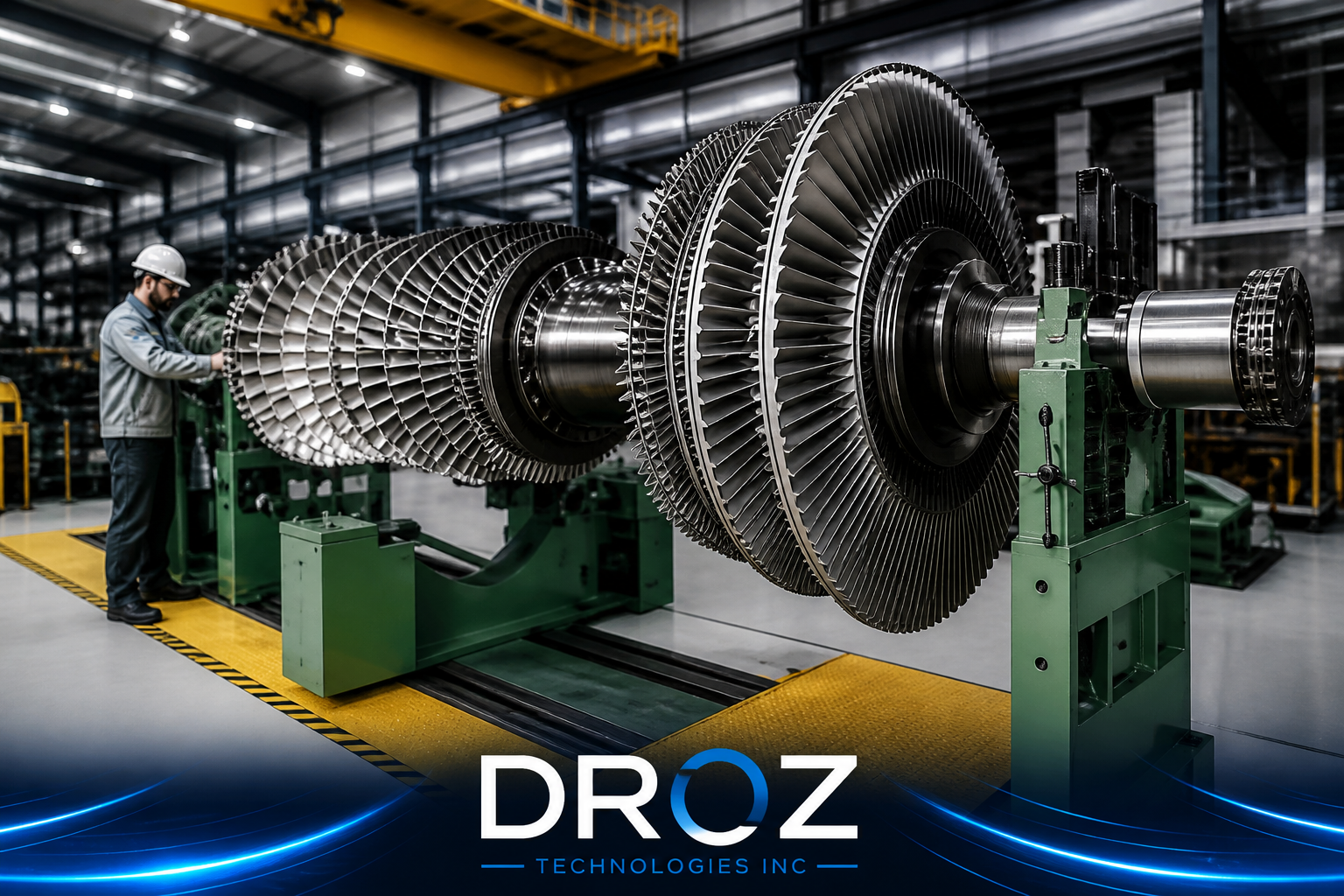
Droz reliability engineer on a turbine field engagement
§ Definition
Predict the failure,
schedule the intervention.

Predictive maintenance is the practice of measuring an asset's condition while it is running, recognizing the early signature of a failure mode, and scheduling the repair before unplanned downtime occurs. Droz's predictive maintenance practice is built on four diagnostic disciplines — vibration analysis, thermography, ultrasound, and laser alignment — run by senior field engineers and indexed against twenty years of reference data. Programs are scoped to your critical asset population, calibrated to your plant cadence, and integrated into your existing CMMS so recommendations land where the work happens. Where applicable, Droz layers AI-driven anomaly detection and failure prediction on top of the field program (see Pillars B and C) so the operating model compounds over time. The result: unplanned downtime cut at the source, OEM tolerances held, and a maintenance budget that converges instead of escalates.

§ Disciplines

Four diagnostic practices, one program.

§ Assets we protect

Equipment we instrument,
across the asset map.

Across rotating equipment, static assets, electrical & control systems, and full production lines — the predictive maintenance practice covers the full plant surface.

DZ-A · Rotating equipment

Primary assets

Focus — condition monitoring, alignment, balancing.

  • Electric motorsLow · medium · high voltage
  • PumpsCentrifugal · process · cooling · transfer
  • CompressorsAir · gas · process
  • TurbinesSteam · gas · hydraulic
  • GearboxesReducers · increasers
  • Fans & blowersIndustrial · HVAC · process air
  • ConveyorsBelt · screw · bucket elevator
  • Mills & crushersGrinding · ball · hammer · jaw · cone
DZ-B · Static equipment

Critical assets

Focus — integrity, monitoring, reliability.

  • Heat exchangersShell & tube · plate
  • BoilersPower · process
  • ReactorsProcess · catalytic
  • Storage tanksAtmospheric · pressurized
  • Piping systemsProcess · utility · cryogenic
  • Pressure vesselsASME-coded
  • Cooling towersInduced · forced draft
DZ-C · Electrical & controls

Power & control systems

Focus — thermography, diagnostics, AI insight.

  • SwitchgearLV · MV · HV
  • Motor control centersMCC enclosures
  • TransformersDistribution · power
  • PLCsProgrammable logic controllers
  • SCADA systemsPlant supervision
  • Industrial instrumentationSensors · transmitters
DZ-D · Production lines

Full lines & process trains

Focus — efficiency, uptime, throughput.

  • Food manufacturingContinuous & batch
  • PharmaceuticalsGMP-regulated
  • Packaging linesPrimary & secondary
  • Automotive linesStamping · assembly · paint
  • Pulp & paperProcess trains
  • Chemical processingContinuous reactors
  • Cement productionKiln · grinding
  • Mining operationsComminution · separation

Each asset family maps to an industry program — see all industries.

§ Engagement model

From sensor data to scheduled repair.

01
Collect
Machine data

Field instrumentation and wireless sensors stream condition data from your critical assets. Scope, sensor placement, and sampling cadence are set by the lead reliability engineer in a kickoff walk-down.

02
Analyze
Pattern recognition

Engineering practice and AI software interpret signal patterns against twenty years of reference data — bearing signatures, motor faults, and gearbox harmonics are matched to known failure modes.

03
Detect
Anomaly detection

Deviations from healthy baselines are flagged before they propagate into failure modes. Severity is graded and routed by criticality.

04
Predict
Failure forecasts

Models estimate remaining useful life and recommend the optimal intervention window so production loss is minimized.

05
Automate
Decision routing

Work orders, alerts, and operator recommendations are dispatched into your CMMS, email, and chat channels — closing the loop with maintenance planning.

§ Predictive vs reactive

The data behind the operating-model switch.

MODE · 01

Reactive maintenance

  • Unplanned downtime dominates — failure happens, then the line stops.
  • Costs are concentrated in emergency repairs and lost production.
  • Spare-parts inventory is over-stocked to hedge against unknown failures.
  • Operating model: firefighting, with no compounding learning between failures.
MODE · 02

Predictive maintenance (Droz model)

  • Failures are flagged at their early signature — bearings, misalignment, partial discharge — before propagation.
  • Interventions are scheduled inside planned maintenance windows; line stoppage avoided.
  • Spare-parts inventory matches forecast demand — capital cost drops.
  • Operating model: a data layer that compounds — every failure detected sharpens the next prediction.
§ Industries served

Where predictive maintenance is the lead engagement.

See all 16 industries served →

§ Standards we apply

Anchored to the standards your auditors recognize.

CMVA

Canadian Machinery
Vibration Association

Droz reliability engineers hold CMVA certification; all vibration programs follow CMVA category and reporting protocols.

ISO 10816

Mechanical vibration
evaluation

Acceptance and severity thresholds for rotating machinery vibration are assessed against ISO 10816 zone limits A–D.

Vibration Institute

VI Categories
I–IV

Field engineers are certified across Vibration Institute Categories I–IV, the global benchmark for vibration analyst competency.

Full list of associations and certifications →

§ Predictive maintenance
Stop measuring downtime in millions. Start scheduling it inside planned windows.